The environment played an essential role in technological innovations, lifestyle, religion, and politics in pre-Columbia North America. During this time, the Indigenous lived varying lives depending on where they resided and the size of their civilization.
Non-sedentary peoples moved from place to place frequently, and destinations were based on readily available resources. Semi-sedentary groups would set up villages, staying in one place longer than the more nomadic tribes. The reason for this difference is that semi-sedentary peoples tended to come from regions with more natural resources, such as diverse forests with adequate rainfall. They learned to create garden plots, clear them when necessary, or completely move their established village if need be.
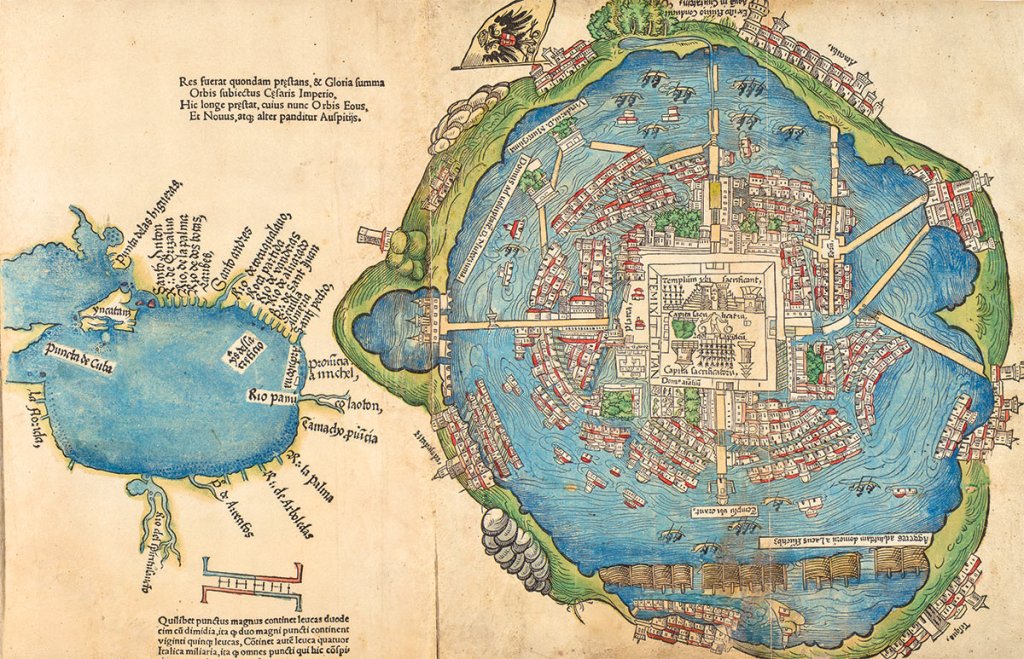
Sedentary people usually lived in massive empire city-states. For example, the surrounding environment quite literally shaped the Aztec Empire’s culture. The capital of Tenochtitlan adapted to and resided on top of Lake Texaco, shaping their religion, culture, and success. However, torrential flooding was a major concern, which is why the Aztec held human sacrifice rituals in hopes the Gods would spare them of natural disasters. Economically, textiles from raw cotton production stapled trade. Likely impacted by torrential flooding, the land was fertile enough to produce hefty amounts of cotton, as estimations show Natives produced 50,000 metric tons of cotton before the conquest.
Textiles from raw cotton production stapled trade for the Aztec. Largely thanks to torrential flooding, the land was fertile enough to produce at least 50,000 metric tons of cotton before conquest began. In Mexico, rivers formed shifting branches which created incredibly fertile lowlands. A region of specific interest would be the “Laguna,” an area within Durango and Coahuila. The soil here had great farming potential, as flooding from the Nazas and Aguanaval Rivers gave it sedimentary qualities. Rain and temperature in the Laguna also heavily impacted residents, water bodies held vast wildlife forms, many of which were essential protein sources for peoples in the region.
Once New Spain was established, Alexander von Humboldt visited in 1803 through 1804 and made accounts stressing the cotton production potential. He specifically noted that in 1791, New Spain had exported six times more cotton than the United States. However, that stressed observation aged sourly, as the U.S. cotton gin, invented in 1793, got rid of time-consuming tasks, like manually separating seeds from lint. Though, technology and agricultural theory continued to advance in Mexico. In 1885, the Ministry of Industry and Development published a manual made by a Laguna farmer, Donato Gutierrez of Durango, explaining how to grow the desired cotton plant. The best method described was to plant in rows, so the farmers could make necessary calculations more accurate.
Farmers planting in muddy clay-like soils started planting a type of cotton that could withstand harsher conditions, but with the disadvantage of annual replanting. The new cotton genus yielded 250 kilograms of cotton per hectare, compared to the 54 kilograms produced by the previously most popular genus. The new strain also needed more irrigation and water, leading to long-term disputes. The first federal water law was passed in 1888, granting water allowances to the new, politically-connected Mexican company, Tlahualilo. As the new company emerged, so did an era of technologically superior agriculture, called aniego. This form of agriculture conserved water and the soil’s moisture alike, and farmers would extend their land’s irrigation by implementing small diversion dams, and canals.
In 1892, Mexican President Porfirio Diaz received investigative reports on how to resolve disputes (from the Nazas River Inspection Commission that Diaz himself established) between Tlahualilo (upriver) and downriver water users. An engineer in the commission named Marroquin y Rivera noted it was an “indisputable fact the material forming the present terrain in the region was to a great depth deposited by the waters of the Nazas… layered with three to four inches of sediment.” During this time of aniego, farmers also rearranged irrigation methods based on specific ecological conditions. In the 1880s, so going back just a few years, railroads arrived. The expansion of the rail system also brought along expansions in aniego, simultaneously creating a national market for not just the agricultural sphere, but an emerging industrial frontier. As aniego expanded, so did conflicts among water users. The Federal Law on General Means of Communications (1888) extended federal jurisdiction over the road and railways to differing international border waterways. Congress then proceeded to pass regulations in 1891, 1895, and 1909… each of which came from a deeper understanding of the Nazas River’s hydrology. These regulations established a group of elite policymakers, designed by Porfiria Diaz’s regime.
By Independence in 1821, the Nazas and Aguanaval Rivers had been transformed (in comparison to pre-Columbian times) by an exclusive hydrological system, where irrigation systems within streams connected the two major flows. High land fertility from differing water levels made for fertile lands, which in this case, was gold for cotton production. As Fransisco Madero noted, the Nazas’ effect on land and its ability to produce profitable crops turned Torreon (originally a small village) into a fast-paced rail entrepot within fifteen years. Even before Independence, Madero observed the Nazas importance within Mexico, wanting to build a dam and resolve water disputes between landowners.
The 1895 regulation passed by Congress took the Tlahualilo Company’s water distribution from 200 million cubic meters to 22 million, which downriver users thought of as a personal success. While the company proceeded to overlook the regulation, downriver users largely began using innovative hydraulic methods to increase their cultivation, which created even more water scarcity. Once investigators found that Tlahualilo had made false claims regarding profits, American and British investors gained control of the company, not helping ease any tensions. In 1908, an executive order was issued, forbidding upriver users from diverting river flow during September, so downriver users could use the entirety.
In 1909, Francisco Madero, the prominent leader of the Revolutionaries fighting against Porfiria Diaz’s autocracy (Library of Congress), proposed his desired dam as part of a new Mexican political economy. However, the proposition was denied. In 1911, the Supreme Court made a final ruling against the Tlahualilo company, which did rule in Diaz’s favor. However, the sense of victorious closure did not last long, as Madero’s Revolutionary forces triumphed over the armies of Porfiria Diaz and the state in critical battles, leading Profiria to resign and flee to France. Ultimately, water disputes among Mexican landowners along the Nazas and Aguanaval Rivers were powerful influences on Porfirias autocracy, as political backings by farmers compounded not just frustrations with the state over water, but also other underlying and more direct issues.






 GWYNETHICS
Leave a comment