All throughout history, stories of the sacred tree have been told. This mythological theme often describes the tree in question as having roots buried within the depths of the earth and branches that extend beyond the heavens. Details vary based on time and location, but we do find a commonality. A sacred tree represents life, death, transformation, and mysteriousness; whatever mystery lies within the tree leads humankind toward something important, a greater good.
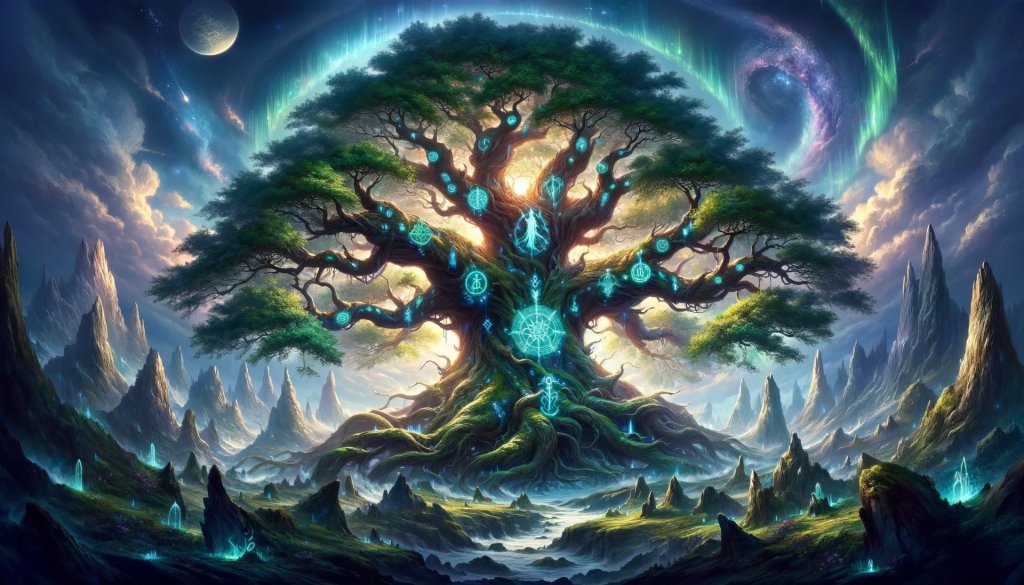
Sacred trees are the intertwining of what it mortal and limited to what is immortal and infinite.
The Cosmic Tree myth, originating from India, represents the universe or cosmos in full bloom. It portrays the Universe as an inverted tree, with roots in the sky and the branches being earth itself – air, fire, water, and earth being making up those branches. The cosmic tree demonstrates creation as a descending force, something that is subjective and consequential. Not only do the branches make up the elements, but the things necessary for human life.
If we connect the elemental branches to humanity, we can begin to notice a synchronicity between the branches and human behavior. Water correlates with intuition, empathy, and emotion; fire is seen in man’s knack for war, anger, and adventure; air can be thought of as being connected to intelligence, the flow of life, and communication; the earth itself is undoubtedly what grounds us, giving humankind a sense of calm, patience, and longevity.
The Norse Yggdrasil Tree, also coined the Tree of Wisdom and the Tree of Life, is a particularly esoteric find mythology. The tree connects all of the universe with its three great roots. One leads to Asgard, the plane of the gods and light elves. The second root extends to Jotenheim, which is below the Asgardian plane – here you can find men, giants, dark elves, and dwards. The third root is the deepest, ending in the plane of Niflheim – the land of cold and mist, where Hel commands the dead. Below each of these roots is a well. Urd belongs to the Asgardian plane, where Norns stand watch and ensure the tree is sustained; the spring of Mirmir belongs to Jotenheim, and is the pure source of the second roots; Hvergelmir, the Niflheim well, is the home of a great mythological creature and acts as the source of the eleven great floods.
The Tree of Wisdom is not made of goodness, instead it is made up of what seems to be a perfect balance of dark and light forces. Even though planes are separated from another, are they truly, since they are all essential aspects of one larger entity? This entity itself is not linear, even though it does have what, at first, you would think is a beginning and end – there is no start or finish, the entire entity is a model of death and rebirth.
Works Cited
Leeming, D. A. (2019). Part 4; Iceland (Norse): Yggdrasil. In The World Of Myth (3rd ed., pp. 294–295). Oxford University Press.





 GWYNETHICS
Leave a comment