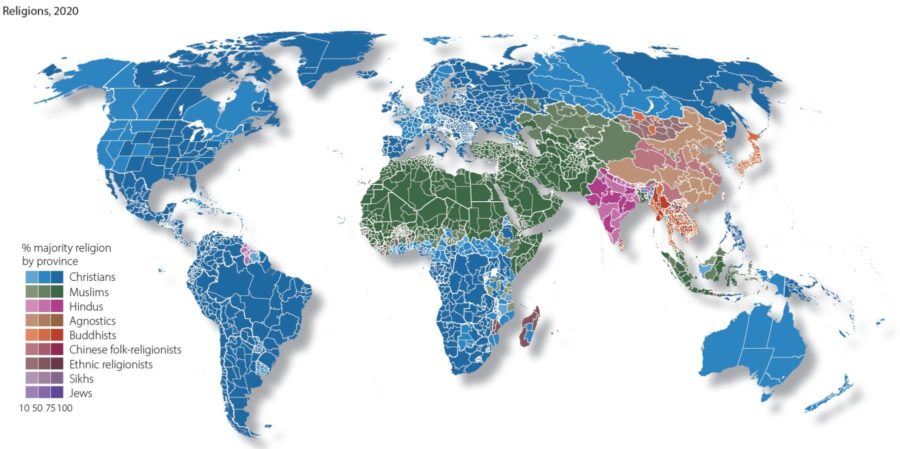

From 300 to 600 C, the entirety of the Afro-Eurasian landmass saw a surge in religious belief and activity. In the West, Christianity eventually became the official faith of the Roman Empire. Meanwhile, Buddhism spread across northern India, central Asia, and China. Buddhism and Christianity appealed to incredibly diverse populations, and continue doing so today. These religions provided universal principles to follow and a needed sense of community for many. As these religions inspired the masses, they also challenged mammoth power structures as they were formerly known, such as the Roman Empire.
Christianity’s ability to gather so much loyalty may relate to the formation of the teachings of Jesus, whose preaching drew from Jewish models, alongside the Egyptian and Mesopotamian images of the great king being a shepherd of his people. Jesus took this concept to an entirely new level, now becoming more intimate and spiritual. Additionally, core elements of Christianity included a responsibility to care for the poor, the sick, and regular people. The religion truly began gaining serious traction in political life whenever the Roman Emperor Constantine converted to Christianity and legalized it throughout the empire. Churches became new urban public forums, and in return for tax exemptions granted by Constantine, bishops became responsible for the poor. With the Nicene Creed in 325 CE, Christian communities were unified through the balancing of different aspects of the divine – consequently, the religion became more of a centralizing force than the state, aiding in the fragmentation of the Roman Empire.
In a somewhat similar regard within primarily Northern India, the Buddha challenged traditional power relationships and established social hierarchies that were based on birth and the power of ruling priests and warriors. Buddhism’s appeal to diverse populations in India, central Asia, and China allowed it to transcend traditional power structures based on rigid social stratification. However, this appeal would have likely never been possible if it were not for the missionary efforts of Buddhist monks. An example of Buddhism’s far-reaching influence – two gigantic statues of Buddha carved into the stone face of a cliff within a valley of the Hindu Kush; those statues remained there until 2001, when they were dynamited by the Taliban. Travelers were also able to find welcoming cave monasteries all the way from the Taklamakan Desert to northern China.
The Buddha laid out the spiritual tenets of the Four Noble Truths and the Eightfold Path, providing people with alternatives to established social and religious norms. However, Buddhism also had something a counter-effect on rural areas within India, as Buddhism was most popular in urban regions. These rural people refashioned their traditional Brahmanic religion to align with agrarian values – and it turned into what we know today as Hinduism. This belief system unified South Asia as a distinct cultural region – also called a Sanskrit cosmopolis – based on Hindu spiritual beliefs.
In a way, both Christianity and Buddhism were forces that changed the nature of traditional power relationships. While religion had long-been a centralizing force of societies, Christianity and Buddhism took this centralization far beyond their respective “borders,” showing just how unifying and influential religion can be, not just not a societal scale, but on a global scale. Their adaptability and missionary efforts allowed them to flourish, making religious ideas more influential and far-reaching than the empires and hierarchies of their time.
Bibliography
Pollard, Elizabeth, et al. Worlds Together, Worlds Apart. W.W. Norton and Company, 2019.







 GWYNETHICS
Leave a comment