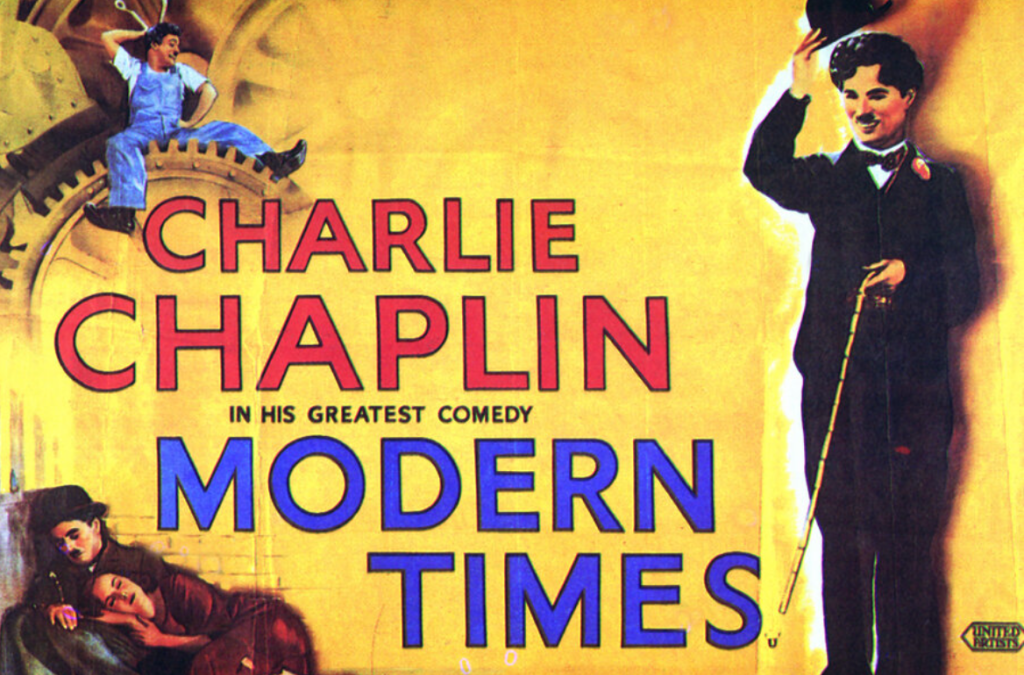
The movie starts off with Charlie Chaplain, the main character, working an assembly line in a factory. In the introduction of the movie, we get a comically deep visualization of what it is like to “work the line.” The tasks are repetitive, oftentimes the line goes so quickly that an individual cannot keep up, and bosses are breathing down your neck to ensure you do not slack off or get too far behind. To show just how intense the repetitions are, when the main character is allowed to stop working, he is somewhat involuntarily making the repetitive movements that he would if he were working. While the depiction is meant to be seen as comical, it definitely must have been funnier to audiences when this movie was released, because they could probably relate to it better.
Movies such as this one became popular among average Americans in the 1920s, whenever the concept of a middle-class truly emerged and families now had enough money to indulge themselves with entertainment. While Modern Times was a movie that appealed to the average person of the day, it also had political undertones masked by comedy. This movie takes place during the Great Depression era, a result of overproduction. The roots of both mass production and mass consumption can be traced back to World War I, which put pressure on increasing technology to produce war materials – quickly. During this time, millions of people were working either in factories or at home, sometimes even both. War items of demand include guns, gas masks, bandages, boots, and much more (Tignor et al. 716).
As more of these materials continued being produced at increasingly faster rates and volumes for lower and lower costs, the face of mass production was born. The World War I era of mass production also came alongside another key mass-produced token of American society – Ford Motor Company. By the 1920s, the Model T car was being produced at a price that was achievable for average working families, and soon, demand was beating supply. To drive up the supply, Ford used mechanized conveyors, in which workers had one repetitive task to do, simplifying the entire production process. This concept isn’t just used for vehicle production though, it’s used in various other industries today.
One of the first concept we see in the movie as well includes organized movements of laborers. During this era, because of the dangerous nature of working in factories and the dehumanization that comes alongside it. In portraying this dehumanization, the movie depicts a company trying to sell his boss a machine that would get rid of lunch hour by automatically feeding workers, therefore increasing production. The boss was curious about the contraption, and had no original thoughts of his workers health, only whether the machine would work or not. Of course, Charlie Chaplain is the one chosen to test drive the machine. While it worked fine at first, it slowly began to mess up, and left Chaplain being practically assaulted by a corn on the cob feeding machine. More smaller aspects of the machine also failed to work right, leaving him to get soup thrown on him and hit repeatedly in the head. Seeing all of this, the boss declines the option of buying these machines. Not for how dehumanizing they were, but because they were not practical.
Attitudes of non-care toward workers was an issue of this time, and if we’re being honest, today as well, but it was far more dangerous and devastating during this time. After having a “nervous breakdown” at work, getting fired, and leaving the hospital – Charlie gets stuck in the middle of a communist protest, likely along the lines of labor workers’ rights. With Ford being the first company to truly get the mass production wheel rolling, it’s interesting to watch this movie today, as the biggest automakers strike in America in decades is now in a tentative deal stage, with United Auto Workers members voting to ratify contracts up to 2026. Protests regarding labor continue to this day, and while strikes died down for awhile, they are gaining more and more traction today. The United Auto Workers union got some very desirable benefits because of their strike, not just from Ford, but also Stellantis and General Motors. The concepts we’re seeing in Modern Times set nearly a century ago aren’t too far off from what we’re seeing today.
However, laborers working the assembly line in America weren’t the only ones facing harsh expectations from their employers – indeed, if you look further South into Central American, you’ll find that U.S. companies were making their rounds there as well. United Fruit Company, for example – bought up and owned bunches of land in countries across the region, then monopolized over their economies, in which locals had practically no other option than to work for the slave-like wages being offered by Fruit Co. I was reminded by this whenever Chaplain’s love interest is first introduced, at what seems to be a port stealing bananas. While the struggles of factory workers in America were being noticed, and changes were on the way, it would be much longer for those in Latin America, and for some such as in Guatemala, still work on banana plantations to this day. Modern Times shows the roots of American overconsumption and mass production, but today, its definitely more consumption than it is production.
References
Modern Times. Charles Chaplin, 1936.
Tignor, Robert, Jeremy Adelman, Stephen Aron, Stephen Kotkin, Suzanne Marchand, Gyan Prakash, and Michael Tsin. Worlds together, worlds apart. 4th ed. Vol. 2. New York: W.W. Norton & Company, 2014.



 GWYNETHICS
Leave a comment