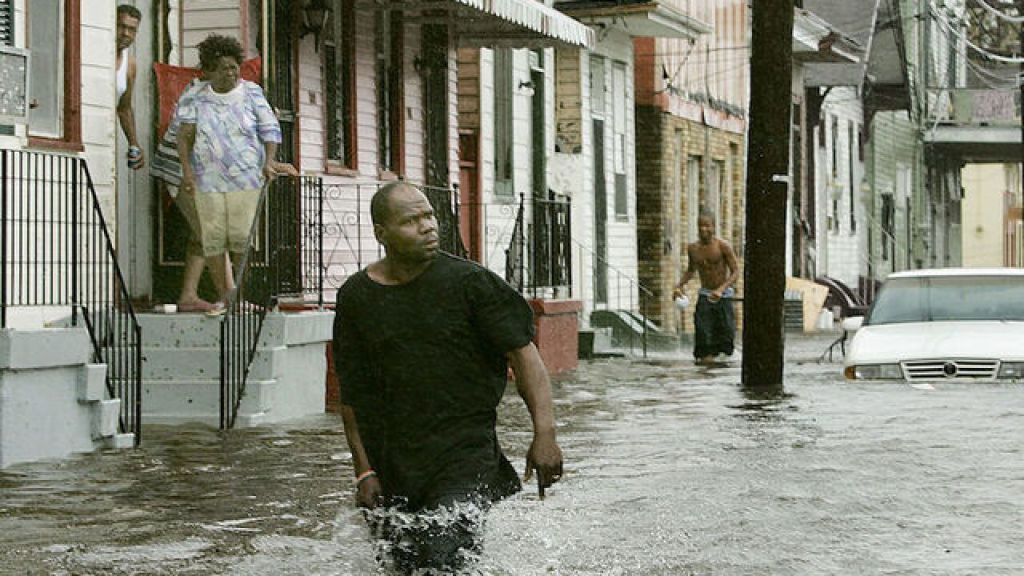
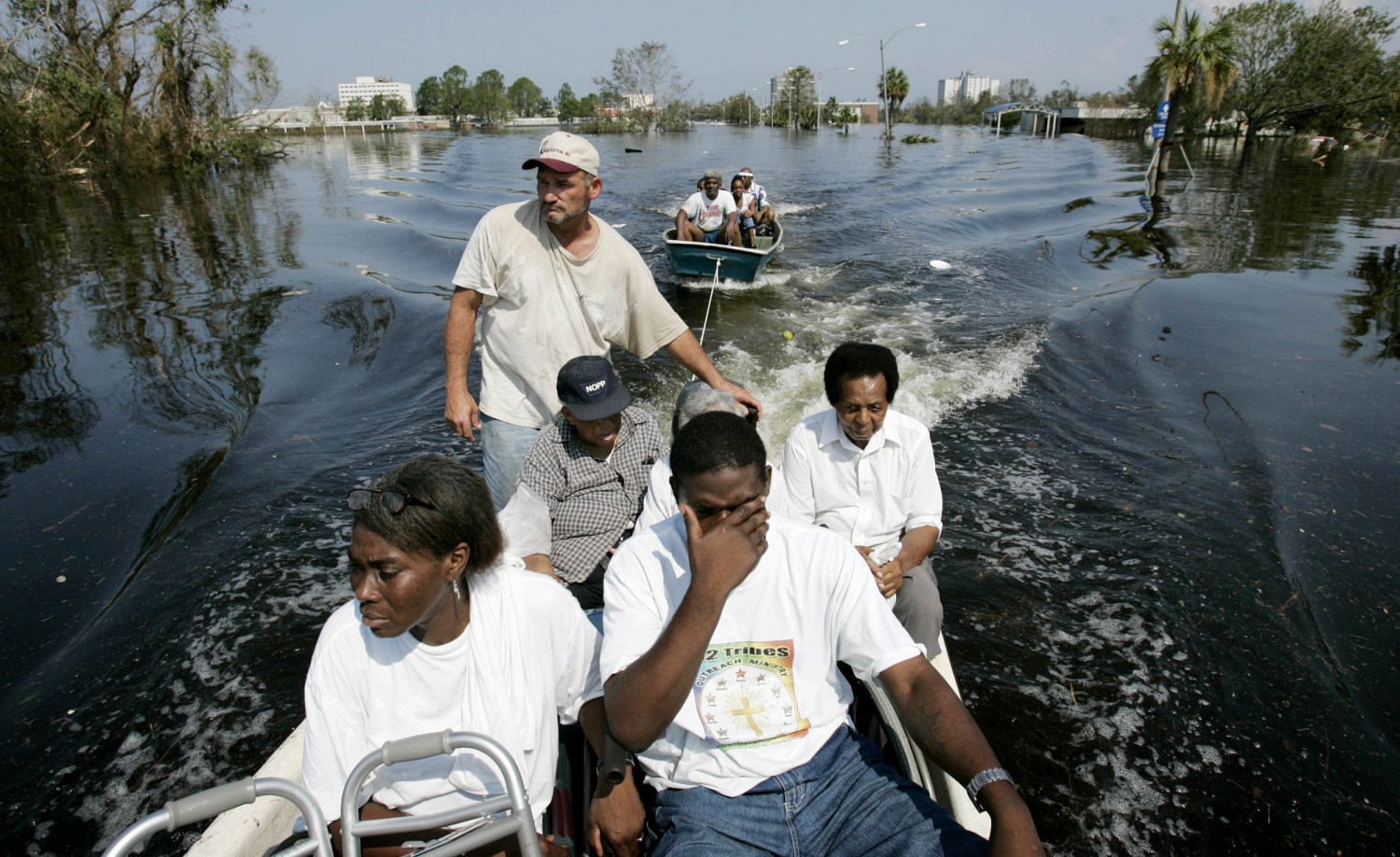
In The Cultural Visualization of Hurricane Katrina, Nicola Mann and Victoria Pass explain the negative impacts of visual media coverage in the wake of Hurricane Katrina. As the analysis explains, from August 23rd and September 1st of 2005… at least 1,836 people lost their lives in the hurricane and its subsequent floods. This event induced mass-scale human suffering that was only amplified by “government uncertainty and inept relief efforts.” On top of the harm inherently committed by the natural force, the event also brought in long-standing and deep-rooted political consequences. Unfortunately, much of those negative political impacts are due to media negligence, as reporting often failed to properly contextualize what video and photo portrayals were unable to show.
The disaster in New Orleans captured the media’s attention quickly, not only due to the intense heartbreaking reality unfolding, because also due to the city’s long history as a home of cultural diversity and tourism attraction. Upon the media’s arrival to Louisiana, cameras fixated on a horrific scene: hundreds of thousands of mostly lower-class, African-American people crammed into the New Orleans Superdome; children and the elderly stranded on rooftops without food or water; and bloated corpses floating in floodwaters. All of this was amplified by the delay in emergency response by federal, state, and local authorities, which quickly turned into a major scandal – even on the international level.
Despite all of this, much of mainstream news coverage shifted gears, turning to reporting methods that characterized victims as looters and criminals while framing the city itself as a place of lawlessness. On September 1st, Louisiana Governor Kathleen Blanco authorized soldiers to shoot to kill looters in an effort to restore calm. One photo, taken by Dave Martin with the Associated Press, “depicted a young African-American man wading through chest-deep water. Clutching a case of Pepsi soda and pulling a floating bag behind him, Martin describes him as ‘looting a grocery store.’” Another photo, taken by Chris Graythen with Getty Images, “shows a white couple up to their chests in the same dirty water. Next to a photograph of a woman holding some bags of food, Graythen characterizes her actions as ‘finding bread and soda from a local grocery story.’” Disparities such as these were all too frequent in reporting of Hurricane Katrina.
Later investigations show that stories about the city’s state of “anarchy” were largely exaggerated. As for the events within the Superdome, the reality within the center was grotesque. It was a densely populated building of chaos, with thousands of people crammed into one building – people without proper access to food, water, the restroom, and female sanitary products. Many watched their loved ones die in that superdome – whether it be from injuries or the lack of life-sustaining technology – with nowhere other than a free space to put the corpse of their lost loved one.
In my opinion, it is crucial to show the hell that is devastation such as Hurricane Katrina, but it is even more important to portray the crucial role of political authorities in minimizing human suffering during these times. Additionally, it is important not to incite or propagate double standards on the basis of race, gender, ethnicity, religion, etc. In my view, this unfair perpetuation makes me curious about how mainstream coverage at the time failed to reconsider these prejudiced disparities – were journalists in such a time crunch they went with the rhetoric of their larger affiliates, was there a lack of historical education on human behavior amid catastrophe among journalists, and if that’s not the case, why were these sensationalized reports ever approved to go on air?
Obviously, hindsight is 20/20, but if this event were happening today, I know what my reaction would be. I imagine my actions would mirror that of what I’m currently doing presently with the Israel-Hamas War. While I’ve been producing coverage on this conflict, the content I have access to is, in my view, unbothered by the bombings that have killed thousands of innocent, non-Hamas Palestinians living in Gaza. Still a week later, much of the coverage I’m able to use is focusing on the initial attack by Hamas on Israel, including little to no context about what’s arguably the most convoluted violent conflict in modern history. This could be because the U.S. and Israel and strong allies, and straying from that dynamic could be seen as problematic, but I feel it is most ethically important to provide coverage on not just the death and brutalization of innocent people, but also the historical facts leading up to the latest developments.
With that being said, in the case of Hurricane Katrina, I would show us much of the reality as appropriate, but in a portrayal that intertwines all aspects both impacting and impacted by the disaster – human suffering, the delays in federal assistance, the real-time concerns of those delays. In addition I’d be sure not to dehumanize victims during a time of distress, as it’s important to not sensationalize inherent consequences of devastation. In nearly every instance of natural disaster to this extent, when thousands of people are packed into unsanitary conditions, folks have gone days without food or water – chaos ensures, people commit crimes to obtain their needs, and people act out of character. From my view, this is all basic human psychology.
Works Cited
Mann, Nicola, and Victoria Pass, editors. “Issue 16: The cultural visualization of Hurricane Katrina.” InVisible Culture, no. 16, 2011, https://doi.org/10.47761/494a02f6.b6df7330.


 GWYNETHICS
Leave a comment