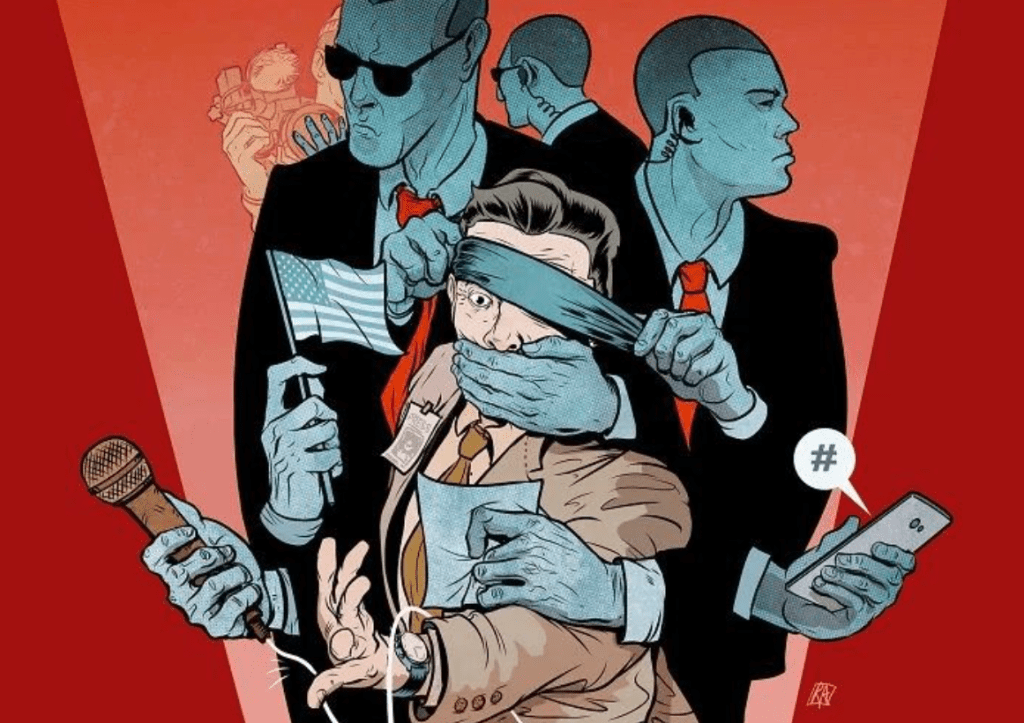

Media censorship is an increasingly complex issue, especially with an expanding world online. Censorship happens in a complex and multi-faceted manner, requiring some form of enabling, ignorance, or intention from several different parties in several different chains of command or power. Media today, as a whole, is like an ecosystem within an ecosystem; other issues such as politics, economics, globalism, and technology all affect and are affected by media. Social media is growing to be a commanding force in this depicted biosphere, and crucially – the other forces that live within it aren’t maturing at the same rate.
The Cambridge Dictionary defines simple censorship as “a system in which an authority limits the ideas that people are allowed to express and prevents books, movies, works of art, documents, or other kinds of communication from being seen or made available to the public, because they include or support certain ideas”.[1] Adding that to the context of media – whether it be television news, print, or social media – we can discern media censorship to be the suppression of information based upon its relation to certain ideas or concepts.

For the United States in 2021, the average time spent on social media was 2 hours and 14 minutes per day.[2]Popular social media sites such as Facebook, Twitter, Instagram, and TikTok have become more than places where people communicate – they are spaces where worldviews are shaped, political movements gain traction, and people can express themselves in a variety of ways. Though, people’s ability to express their views on these platforms are limited to the rules and guidelines of the site itself; meanwhile, Republicans and Democrats cannot seem to agree on when these limitations are acceptable.
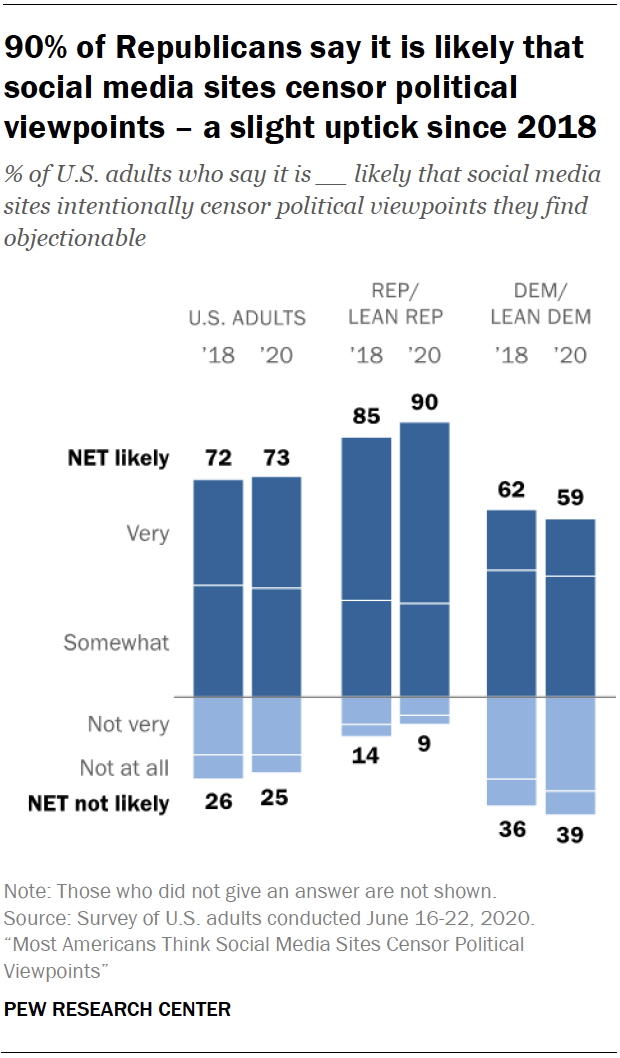
Most people in both parties believe their views are being censored in some fashion on social media, but studies find the belief is most common among Republicans. According to the Pew Research Center, nine out of ten Republicans – along with Independents who lean toward the Republican Party – say it’s at least somewhat likely social media platforms censor political viewpoints the site finds objectionable. Political division holds an immense role in these beliefs as well; about 71% of Republicans say they at least somewhat disagree with social media companies labeling posts as misleading or inaccurate, about 73% of Democrats say they strongly or somewhat approve of this practice.[3]
As mentioned, social media platforms have become a crucial way in which people speak out about their passions. Jeff Rosen – President and Chief Executive Officer of the National Constitution Center – a nonpartisan nonprofit organization that looks to educate the public about the U.S. Constitution[4]describes the power social media has gained in modern discussions; “Facebook” as Jeff puts it, wields “more power [today] in determining who can speak… than any Supreme Court justice, any king or any president.[5] The American Civil Liberties Union also agrees with this assertion, “The biggest social media companies are central actors when to comes to our collective ability to speak – and hear the speech of other – online… while politicians’ advocating hatred or violence may be persuasive… there is also a greater public interest in having access to their speech.”[6]

Companies like Facebook and Twitter have barred former President Donald Trump from using their platforms, due to spreading misleading information. Though, the ACLU is correct in their belief it is within the public’s interest to easily access the statements of predominant political figureheads; since being banned from Twitter, former President Trump has taken to his own platform, Truth Social. Most Truth Social users have flocked to the platform to hear the supposed uncensored views of a leader they support; in consequence, Trump supporters now have their own confined community – and they are not being exposed to the same amount of diverse conversation regarding the former president’s statements.

While censorship tactics such as barring political figureheads from using common social media platforms have inherent issues – that type of censorship is noticeable, blunt, and “in your face.” The example including former President Donald Trump can be seen as a statement from these social media companies – showing they do in fact have the power to control the flow of speech. However, in my view, the more impactful forms of social media censorship can be found within the platform’s algorithms – on TikTok for example, the algorithm pushes posts on your feed that relate to other posts you have liked or interacted with.[7] While TikTok seems to have the most advanced form of this algorithm, nearly every social media site uses similar tactics; this is a form of informational confinement like that of Trump supporters flocking to Truth Social instead of Twitter – most people’s informational consumption is a reiteration of what they already believe or are interested in. Therefore, even those who do not actively seek to affirm their biases are having them non-consensually affirmed by data algorithms.

The bias-affirming tendencies of algorithms is where we can see the deepest roots of censorship – because it’s not just corporate decision-making that affects the flow of information… it’s also an ever-expanding network of data. Though, these algorithms, their processes, and their inclinations are largely impacted in their functioning by the decisions of those who own the platform it belongs to. The decisions of these corporations are impacted largely and foremost by profit. As political tensions between Republicans and Democrats continue intensifying, can we afford these algorithms to keep pushing us away from another? This should be the main focal point of discussions around media censorship – and the conversation of whether censorship favors Republicans or Democrats is frankly pointless, but again, fueled by these algorithms.

To fix the issues of media censorship, specifically social media censorship, we must first understand this is not an issue that can be fixed – or “regulated – by itself. Again, censorship is just one hand stroke within a much larger painting. Then, we must hold social media companies and their algorithms liable for isolating, bias-affirming tendencies – while also ensuring we do not discourage free flows of information. The topic of social media regulation is a conundrum – but it’s only a conundrum because we are limiting our solutions to those similar to what we’ve seen before. It is very important to consider the past as we fix modern issues – but something people forget is that the most groundbreaking solutions were innovative.

As the reality our society finds itself in continues innovating seemingly without effort – we must innovate our problem-solving skills, our approaches to modern issues, and start creating new forms of “regulation” that circumnavigate the restraints of corporate interests and government interference. I am against media censorship – but I am not against the commonsense regulation of corporations that control flows of information. Ensuring these companies prioritize democracy, truthful information, and fairness is not censorship – the only reason it’s considered so is because people assume regulations must be tied to governmental and corporate interests. This does not have to be the reality – through the process of maturing our society, we can create “organizations” (the only word that fits – we could also innovate a more fitting word) to regulate these companies separate from the pursuits of elite business owners, leaders, and other established authorities.
Works Cited
“Censorship.” CENSORSHIP | Definition in the Cambridge English Dictionary, dictionary.cambridge.org/us/dictionary/english/censorship. Accessed 24 June 2023.
Heins, Marjorie, et al. “The Brave New World of Social Media Censorship.” Harvard Law Review, 24 Mar. 2023, harvardlawreview.org/forum/vol-127/the-brave-new-world-of-social-media-censorship/.
“Jeffrey Rosen.” National Constitution Center – Constitutioncenter.Org, constitutioncenter.org/about/board-of-trustees/jeffrey-rosen. Accessed 24 June 2023.
Smith, Ben. “How Tiktok Reads Your Mind.” The New York Times, 6 Dec. 2021, http://www.nytimes.com/2021/12/05/business/media/tiktok-algorithm.html.
Vera Eidelman, Kate Ruane. “The Problem with Censoring Political Speech Online – Including Trump’s: ACLU.” American Civil Liberties Union, 24 Feb. 2023, http://www.aclu.org/news/free-speech/the-problem-with-censoring-political-speech-online-including-trumps.
Vogels, Emily A. “Most Americans Think Social Media Sites Censor Political Viewpoints.” Pew Research Center: Internet, Science & Tech, 19 Aug. 2020, http://www.pewresearch.org/internet/2020/08/19/most-americans-think-social-media-sites-censor-political-viewpoints/.
“Which Countries Spend the Most Time on Social Media?” World Economic Forum, http://www.weforum.org/agenda/2022/04/social-media-internet-connectivity/. Accessed 24 June 2023.
[1] “Censorship.” CENSORSHIP | Definition in the Cambridge English Dictionary, dictionary.cambridge.org/us/dictionary/english/censorship. Accessed 24 June 2023.
[2] “Which Countries Spend the Most Time on Social Media?” World Economic Forum, http://www.weforum.org/agenda/2022/04/social-media-internet-connectivity/. Accessed 24 June 2023.
[3] Vogels, Emily A. “Most Americans Think Social Media Sites Censor Political Viewpoints.” Pew Research Center: Internet, Science & Tech, 19 Aug. 2020, http://www.pewresearch.org/internet/2020/08/19/most-americans-think-social-media-sites-censor-political-viewpoints/.
[4] “Jeffrey Rosen.” National Constitution Center – Constitutioncenter.Org, constitutioncenter.org/about/board-of-trustees/jeffrey-rosen. Accessed 24 June 2023.
[5] Heins, Marjorie, et al. “The Brave New World of Social Media Censorship.” Harvard Law Review, 24 Mar. 2023, harvardlawreview.org/forum/vol-127/the-brave-new-world-of-social-media-censorship/.
[6] Vera Eidelman, Kate Ruane. “The Problem with Censoring Political Speech Online – Including Trump’s: ACLU.” American Civil Liberties Union, 24 Feb. 2023, http://www.aclu.org/news/free-speech/the-problem-with-censoring-political-speech-online-including-trumps.
[7] Smith, Ben. “How Tiktok Reads Your Mind.” The New York Times, 6 Dec. 2021, http://www.nytimes.com/2021/12/05/business/media/tiktok-algorithm.html.



 GWYNETHICS
Leave a comment